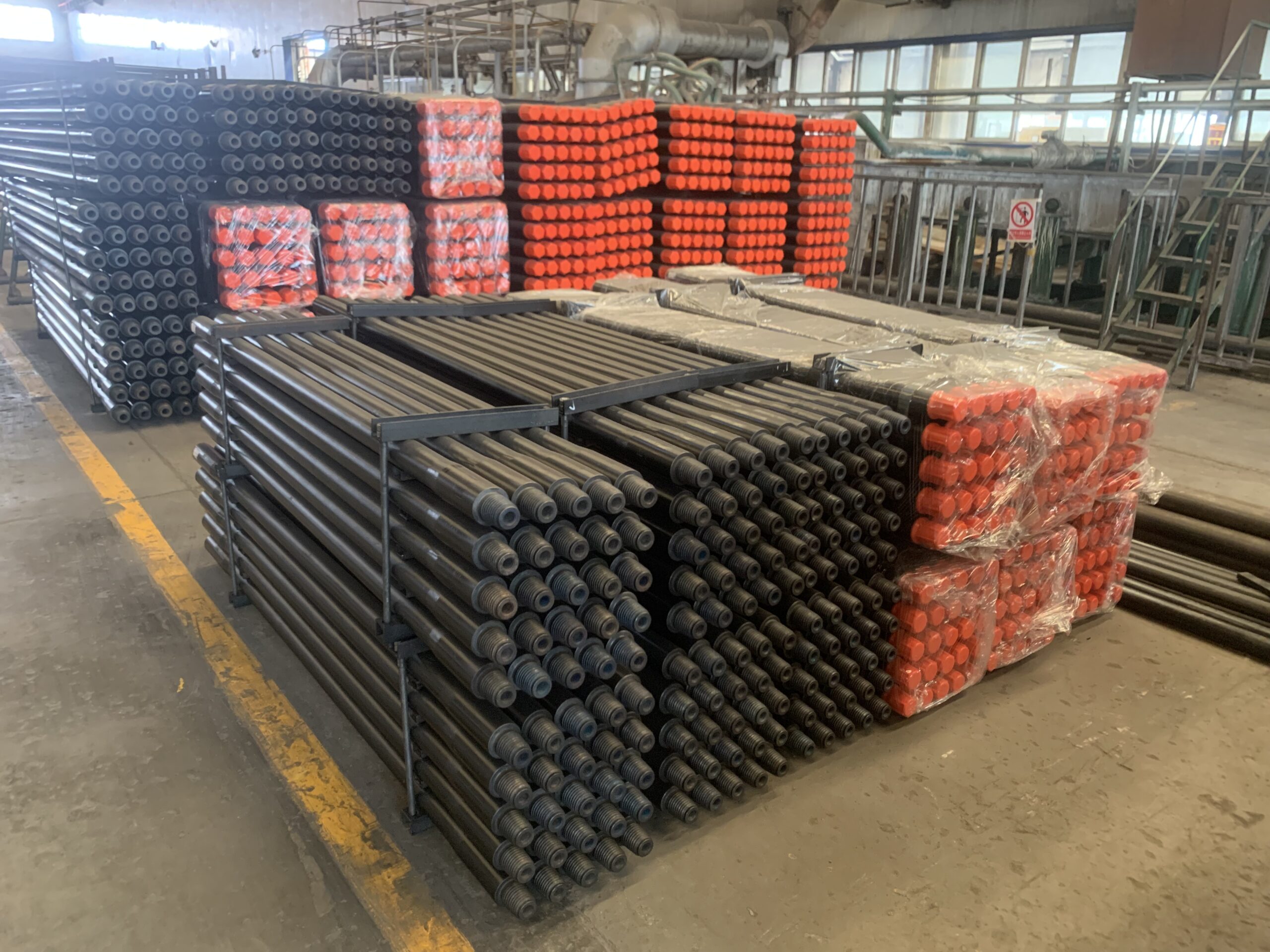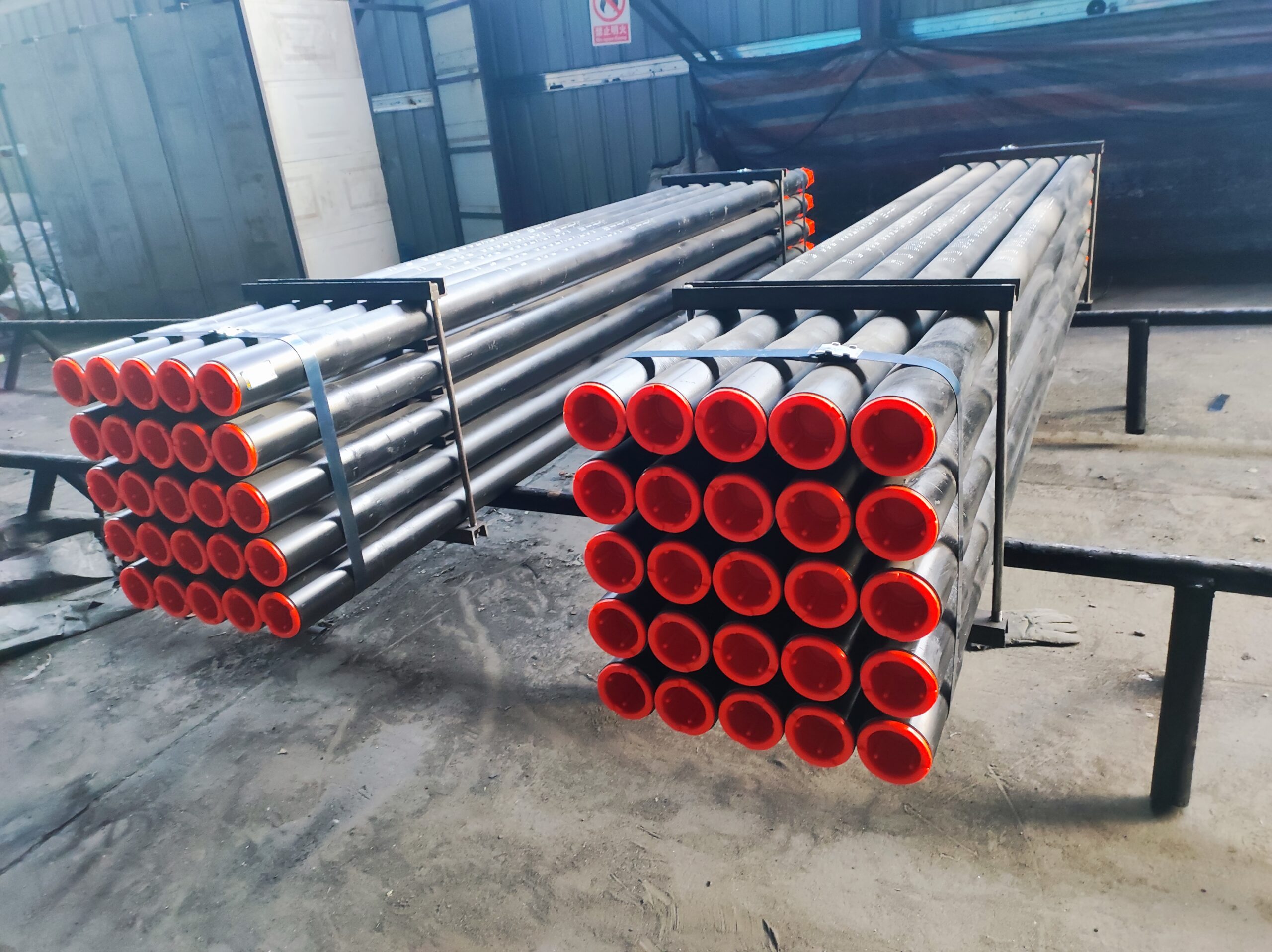
Drill pipe may look like a relatively simple steel product, but manufacturing a reliable drill rod requires precise control of steel quality, forming, heat treatment, machining, threading and inspection.
For HDD drill rods, the requirements are even more demanding because the pipe must withstand repeated torque, thrust, bending and make-up/break-out cycles.
Understanding the complete drill pipe manufacturing process is useful for drilling contractors, importers, distributors and engineering companies because production methods directly affect product quality, service life and final purchasing cost.
1. Overview of the Drill Pipe Manufacturing Process
A typical drill pipe or HDD drill rod manufacturing process can be summarized as:
Raw Material Inspection → Cutting → Forming/Forging → Tool-Joint Manufacturing → Welding or Integral Forging → Heat Treatment → Straightening → CNC Machining → Threading → Surface Treatment → Inspection → Marking → Packing
The exact process varies depending on the drill pipe design.
Some HDD drill rods use forged construction, while other products use a pipe body combined with tool-joint components.
2. Raw Material Inspection
The first step is selecting and inspecting the raw material.
Depending on the product, the manufacturer may use high-strength alloy steel tubing, steel bars, forged components or specially processed pipe material.
Important inspection items include:
- Chemical composition
- Material grade
- Dimensions
- Wall thickness
- Surface condition
- Mechanical properties
- Material traceability
Material traceability is especially important for export orders because buyers may need documentation corresponding to each production batch.
3. Cutting and Preparation
The raw material is cut to the required production length.
The cutting process needs to maintain:
- Correct length
- Proper squareness
- Low deformation
- Clean ends
Poor preparation at this stage can create problems during subsequent welding, forging or machining operations.
4. Tool-Joint Manufacturing
Tool joints are manufactured separately or formed as part of the overall drill-rod production process depending on the design.
The tool joint provides the additional material required for the connection.
Compared with the pipe body, the tool joint normally has a substantially larger outside diameter and a stronger connection section.
Its main functions are to:
- Transfer torque
- Transfer thrust and pullback load
- Protect the pipe connection
- Provide sufficient thread engagement
- Allow repeated make-up and break-out
5. Welding, Forging or Integrated Connection
Different drill pipe designs use different connection technologies.
For some products, the tool joint and pipe body are joined using a controlled welding process. For other products, forging or integral manufacturing methods are used.
The connection area must be carefully controlled because it can become a high-stress region during drilling.
Typical quality-control items include:
- Alignment
- Concentricity
- Weld quality where applicable
- Heat-affected zone
- Surface defects
- Dimensional accuracy
6. Heat Treatment
Heat treatment is one of the most important stages in drill pipe manufacturing.
The objective is to obtain the required combination of:
- Strength
- Toughness
- Hardness
- Fatigue resistance
- Dimensional stability
A typical treatment may involve controlled heating, quenching and tempering.
The exact parameters depend on:
- Steel grade
- Pipe diameter
- Wall thickness
- Tool-joint design
- Required mechanical properties
API Spec 5DP includes requirements concerning chemical composition, microstructure and tool-joint hardness for applicable oilfield drill pipe.
This is one reason buyers should not compare drill pipes only by the price per piece.
7. Straightening
Heat treatment can introduce dimensional changes or residual stress.
The pipe may therefore require controlled straightening.
Straightness is particularly important for HDD applications because drill rods must operate along a controlled curved bore path.
Excessive permanent deformation can affect:
- Steering response
- Torque transmission
- Bore accuracy
- Pipe fatigue life
- Connection alignment
8. CNC Machining
After heat treatment and straightening, critical surfaces are machined.
Typical machining operations include:
- Tool-joint turning
- Bore machining
- Shoulder machining
- Thread machining
- Diameter finishing
- End-face machining
Modern CNC equipment helps maintain repeatable dimensions across large production batches.
9. Thread Machining
Threading is one of the most technically sensitive operations.
The thread must match the mating component exactly.
An HDD drill rod connection typically includes:
- Pin
- Box
- Thread flank
- Shoulder
- Nose/contact area
These components work together to transfer drilling loads.
Vermeer notes that HDD rod connections rely on proper engagement of the pin nose, shoulder and thread flank. Improper connection geometry can lead to uneven loading and accelerated wear.
Therefore, thread inspection should be treated as a critical quality-control operation.
10. Surface Treatment and Protection
Depending on product design and customer requirements, drill pipe may receive surface protection or specialized treatment.
Possible processes include:
- Cleaning
- Phosphate treatment
- Protective coating
- Thread protection
- Rust prevention
- End-cap installation
Thread protectors are particularly important during transportation because even a small amount of thread damage can affect field assembly.
Drill Pipe Manufacturing Cost Breakdown
The final price of drill pipe is not simply the cost of steel.
A simplified cost structure can be represented as:
Raw Material + Forging/Forming + Heat Treatment + Machining + Threading + Inspection + Labor + Energy + Tooling + Packaging + Factory Overhead + Logistics + Profit
The exact percentage changes significantly according to drill pipe diameter, steel grade, connection design, order quantity and manufacturing location.
11. Raw Material Cost
Raw material is usually one of the largest components of drill pipe manufacturing cost.
The cost depends on:
- Steel grade
- Diameter
- Wall thickness
- Tool-joint material
- Steel market price
- Purchase volume
- Material utilization
Higher-strength or specially controlled steel can increase material cost.
12. Forging and Forming Cost
Forging or forming requires:
- Heating energy
- Forging equipment
- Dies and tooling
- Labor
- Equipment depreciation
- Process control
Large tool joints generally require more energy and heavier equipment.
13. Heat-Treatment Cost
Heat treatment consumes both energy and production capacity.
Cost factors include:
- Furnace energy
- Quenching medium
- Tempering
- Loading and unloading
- Process monitoring
- Hardness testing
- Equipment depreciation
For high-quality drill pipe, heat treatment should be considered a value-adding process rather than simply a production expense.
14. Machining Cost
Machining costs depend on the number and complexity of operations.
Major factors include:
- CNC machine hours
- Cutting tools
- Tool wear
- Operator labor
- Electricity
- Machine depreciation
- Production efficiency
Thread machining can represent a significant portion of machining cost because connection accuracy is critical.
15. Inspection Cost
Inspection costs may include:
- Dimensional inspection
- Thread gauging
- Hardness testing
- Tensile testing
- NDT
- Surface inspection
- Documentation
Higher-quality export orders often require more detailed inspection records.
16. Packaging and Logistics
Drill pipe is heavy and long, so logistics can significantly affect the final landed cost.
Packaging may require:
- Bundling
- Thread protectors
- Steel frames
- Wooden or steel packing
- Container optimization
The manufacturer must consider not only the factory price but also container loading efficiency.
Why the Cheapest Drill Pipe Is Not Always the Lowest-Cost Option
Suppose two suppliers offer apparently similar drill rods.
Supplier A offers a lower initial price, but the rods have:
- Shorter thread life
- Greater dimensional variation
- Poorer bending resistance
- More frequent connection damage
Supplier B has a higher unit price but provides:
- Better material consistency
- More accurate machining
- Better heat treatment
- Longer connection life
- More consistent performance
The actual cost per drilling meter may therefore favor Supplier B.
A useful purchasing metric is:
Total Cost of Ownership = Purchase Cost + Maintenance Cost + Failure Cost + Replacement Cost + Downtime Cost
This is particularly important for HDD contractors because drill rod failure can affect the entire project schedule.
Conclusion
The manufacturing cost of drill pipe is the result of many interconnected processes.
Steel quality determines the foundation. Forming and heat treatment determine mechanical performance. CNC machining determines dimensional accuracy. Threading determines connection reliability. Inspection determines whether the final product meets the required specification.
For international buyers, evaluating the complete production process provides a much better indication of drill pipe quality than comparing unit prices alone.