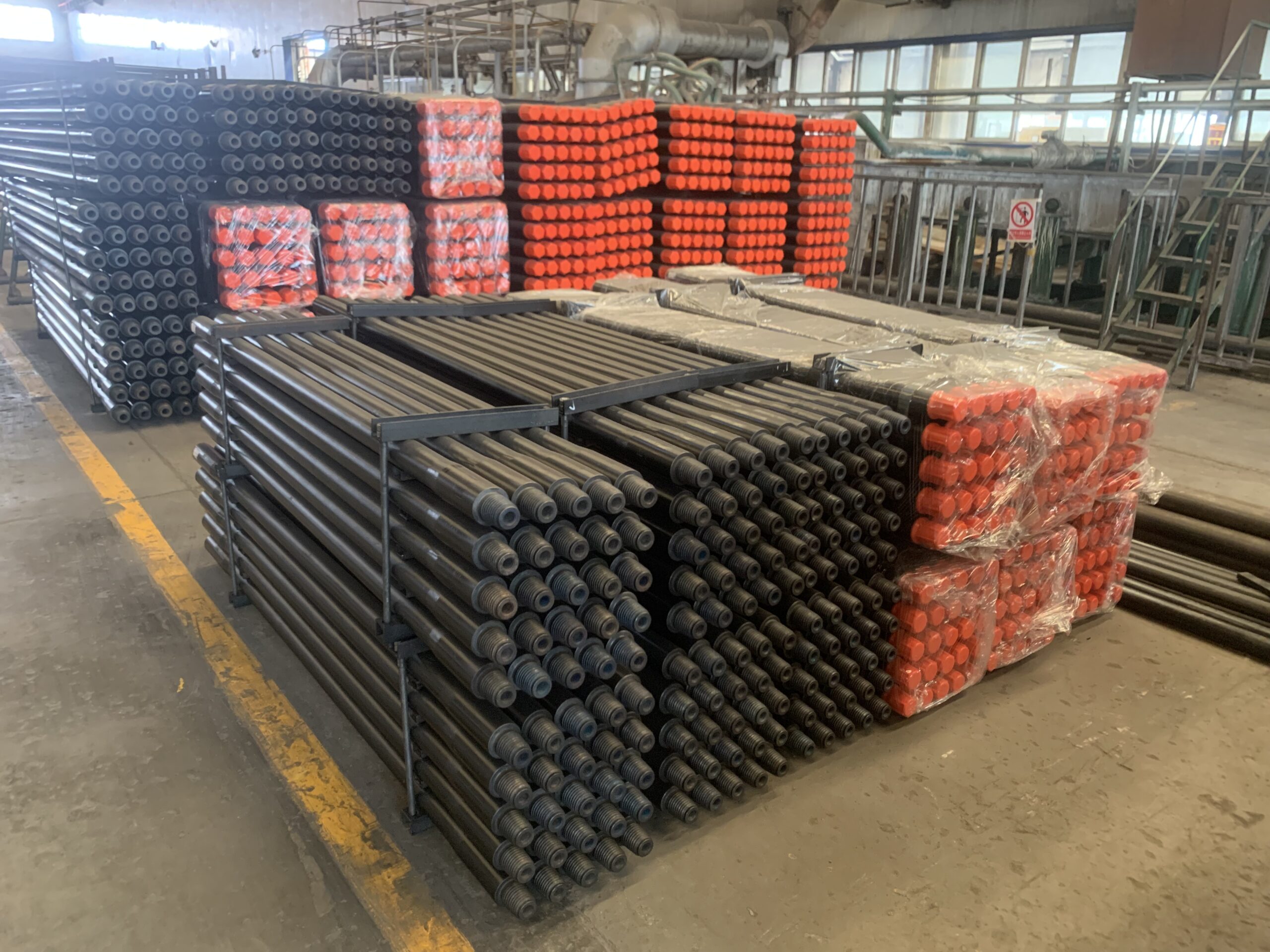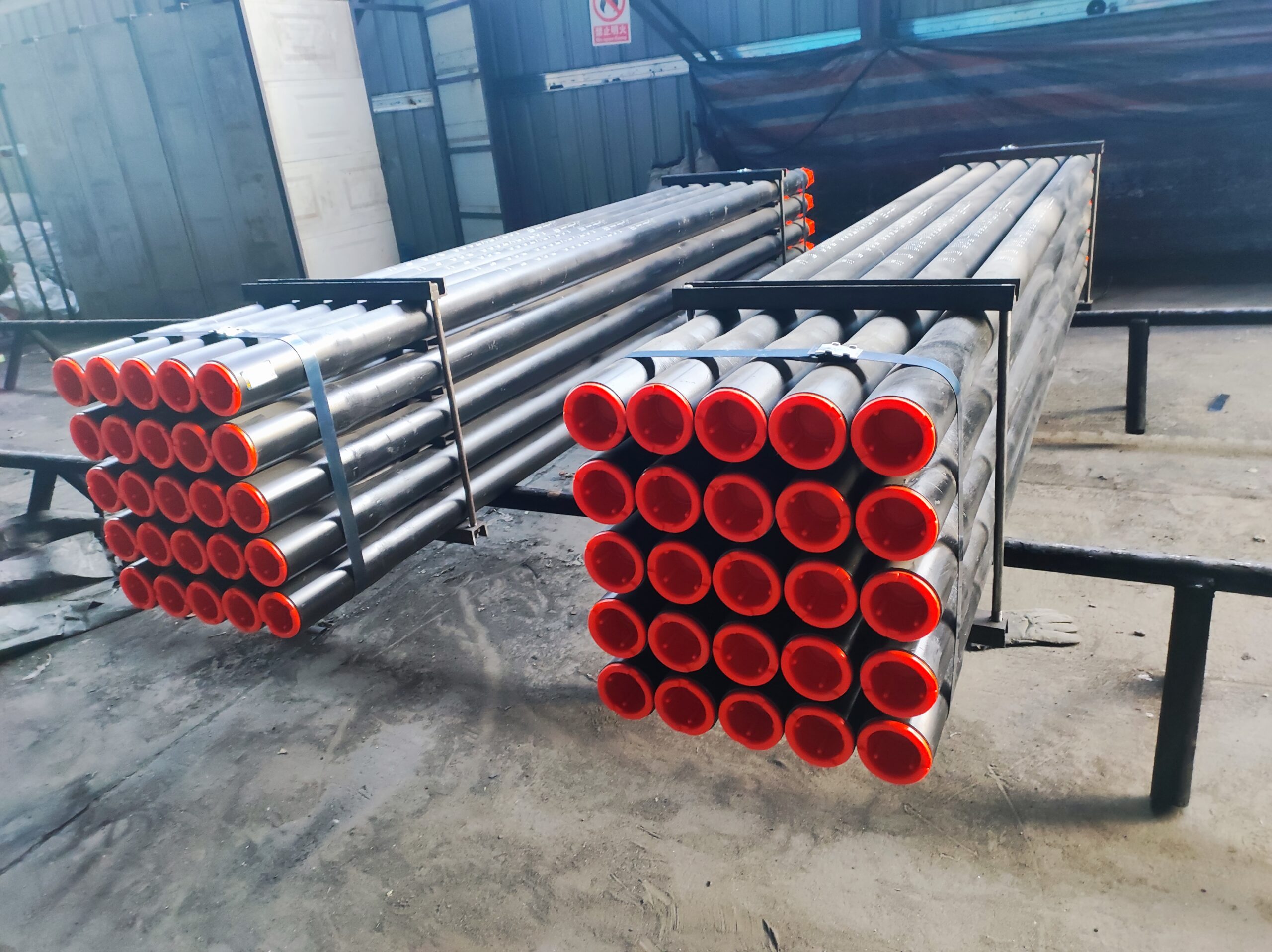
Selecting the correct drill rod is one of the most important decisions in horizontal directional drilling (HDD).
The drill rod must match the directional drill’s spindle, tooling, thread system, torque capacity, bore size and drilling conditions. Choosing the wrong rod can result in poor connection engagement, excessive bending stress, premature thread wear, reduced steering accuracy or even drill-string failure.
This guide explains the most important factors when selecting HDD drill rods, including:
- Drill rod diameter
- Tool-joint diameter
- Thread type
- Working length
- Steel grade
- Bend radius
- Machine compatibility
- Drilling conditions
1. What Is an HDD Drill Rod?
An HDD drill rod is the drill-string component used to transfer rotational torque, thrust and pullback force between the directional drilling machine and the downhole tooling.
A typical HDD drill rod includes:
- Steel pipe body
- Pin connection
- Box connection
- Tool joint
- Thread
- Shoulder
The connection system is especially important because every rod must repeatedly make up and break out during drilling.
Unlike ordinary steel pipe, HDD drill rod is designed to tolerate controlled bending while transmitting mechanical loads.
2. The Five Most Important HDD Drill Rod Specifications
Before ordering drill rods, buyers should confirm at least five specifications:
2.1 Pipe Body Diameter
Typical HDD drill rod diameters include approximately:
- 1.31 in
- 1.66 in
- 1.90 in
- 2.06 in
- 2.375 in
- 2.63 in
- 2.875 in
- Larger sizes for heavy HDD machines
The correct diameter depends on the directional drill model.
For example, the Vermeer D24 uses 2.375-in drill rod with a 10-ft length and #600 thread configuration.
2.2 Tool-Joint Diameter
The tool joint is normally larger than the pipe body.
For example, Ditch Witch documentation for JT25 lists a 2.38-in pipe diameter and approximately 2.75-in joint diameter for its Power Pipe configuration.
Tool-joint diameter affects:
- Torque capacity
- Connection strength
- Bend behavior
- Bore clearance
- Machine compatibility
2.3 Thread Type
The thread is not interchangeable simply because the pipe diameter is similar.
Different machines and rod systems can use different proprietary or industry-specific thread designations.
Examples include:
- Firestick #200
- Firestick #250
- Firestick #400
- Firestick #600
- Firestick #650
- Firestick #700
- Firestick #900
- Other manufacturer-specific thread systems
Vermeer currently lists multiple Firestick drill-rod thread options including #200, #250, #400 and #600.
Ditch Witch tooling documentation also shows compatibility between different models and thread configurations, including #600 and #650 systems.
Therefore, never select an HDD drill rod based only on pipe outside diameter.
2.4 Rod Length
Common HDD rod lengths include:
- 1.5 m
- 1.8 m
- 3.0 m
- 3.05 m
- 4.5 m
- 4.6 m
- 6.0 m
The appropriate length depends on the machine.
For example:
- Vermeer D8x12: 6 ft / 1.8 m options
- Vermeer D24: 10 ft / 3 m
- Vermeer D60S: 15 ft / 4.5–4.6 m
- Ditch Witch JT25: approximately 10 ft / 3 m rods
2.5 Steel Grade
The steel grade must match the mechanical requirements of the application.
High-strength steels are widely used for HDD drill rods because the drill string experiences repeated tensile, torsional and bending loads.
Vermeer, for example, states that its Silver Series drill rod uses one-piece forged S135-grade steel.
However, buyers should not assume that the word “S135” alone defines the entire product specification. Connection geometry, heat treatment, manufacturing process and inspection quality are equally important.
3. Major HDD Drill Manufacturers and Representative Models
There is no single universally accepted global ranking of HDD drill manufacturers based on transparent worldwide unit sales.
However, several manufacturers are particularly important in the international HDD market.
For drill-rod exporters, the most useful approach is to study the machine families and their corresponding rod specifications.
3.1 Ditch Witch
Ditch Witch is one of the major HDD equipment manufacturers, with a broad range of JT-series directional drills.
Representative models include:
- JT9 / JT922
- JT20
- JT25
- JT30
- JT40
- JT60
- JT100
Ditch Witch’s published tooling information shows a wide range of pipe-body and tool-joint dimensions across these machine families.
Ditch Witch Representative Drill-Rod Reference
| Machine | Typical Rod Body OD | Tool-Joint OD | Typical Length | Thread Reference |
|---|---|---|---|---|
| JT9 / JT922 | ~1.58–1.66 in | ~2.00–2.13 in | 6 ft / 1.8 m | DW / #200-class systems depending configuration |
| JT20 | ~2.06 in | ~2.50–2.63 in | 10 ft / 3 m | Model/configuration dependent |
| JT25 | ~2.38 in | ~2.75 in | ~10 ft / 3 m | #600-class / DW connection options |
| JT30 | ~2.38 in | ~2.75–3.00 in | ~10 ft / 3 m | #600-class / model dependent |
| JT40 | ~2.81 in | ~3.13 in | 15 ft / 4.6 m | model-specific |
| JT60 | ~3.06 in | ~3.50 in | 15 ft / 4.6 m | model-specific |
The exact thread and connection should always be confirmed against the machine’s current tooling specification before production.
Ditch Witch’s JT25 specification, for example, lists a 2.38-in pipe diameter, approximately 2.75-in joint diameter and 3 m nominal rod length.
4. Vermeer HDD Drill Rod Selection
Vermeer is another major HDD equipment manufacturer with a broad range of Navigator directional drills.
Representative models include:
- D8x12
- D16x20
- D24
- D40x55
- D40x55DR
- D60S
- Larger Navigator models
Vermeer Representative Drill-Rod Reference
| Machine | Rod Diameter | Rod Length | Thread / Rod System | Example |
|---|---|---|---|---|
| D8x12 | 1.31 / 1.66 in | 6 ft / 1.8 m | Firestick #200 | Manufacturer options |
| D24 | 2.375 in | 10 ft / 3 m | #600 | Firestick |
| D40x55 | 2.38 / 2.63 in | 10 or 15 ft | Model-dependent | Firestick options |
| D40x55DR | 2.63 in outer rod | 10 ft / 3 m | #750 R&R | Dual-rod configuration |
| D60S | 2.875 in | 15 ft / 4.5 m | FSI 900# / 2-7/8FSTI depending generation | Vermeer rod |
The Vermeer D8x12 supports 1.31-in and 1.66-in drill rods with Firestick #200 configurations.
The D24 uses 2.375-in drill rod, 10 ft long, with #600 threads.
The D40x55 platform offers multiple rod options, including 2.38-in and 2.63-in diameter configurations and different lengths.
The D60S uses approximately 2.875-in drill rod and 15-ft rod length. Current D60S specifications identify FSI 900# as the thread type on the current generation.
5. Ditch Witch vs. Vermeer: Why Similar Sizes May Not Mean Compatibility
A common purchasing mistake is assuming that:
Same pipe diameter = interchangeable drill rod
This is not necessarily true.
Two rods may both have a 2.375-in pipe body but use different:
- Thread profiles
- Tool-joint dimensions
- Shoulder geometry
- Pin/box geometry
- Connection lengths
- Torque ratings
- Bend specifications
The connection is the interface between the drill machine and the drill string, so dimensional compatibility is critical.
For example, Ditch Witch and Vermeer systems may use different connection specifications even where the pipe-body diameter appears similar.
6. What Does “Pin and Box” Mean?
HDD drill-rod connections consist of male and female components.
Pin
The pin is the male threaded end.
Box
The box is the female threaded end.
When the drill rods are connected:
Pin → Thread → Shoulder → Box
The connection must achieve proper engagement and load distribution.
Buyers should therefore provide the supplier with the complete connection specification rather than simply asking for:
“2.375-inch drill pipe.”
A professional RFQ should specify:
Machine model + pipe OD + tool-joint OD + thread type + rod length + steel grade + application
7. How to Select Drill Rod for Different HDD Applications
Small Utility Installation
For small fiber, cable and utility projects, compact directional drills commonly use smaller rods.
Typical characteristics:
- Smaller diameter
- Shorter length
- Lower torque capacity
- High steering flexibility
The Vermeer D8x12, for example, uses 6-ft rods in 1.31-in or 1.66-in diameter configurations.
Medium HDD Projects
Medium machines often use rods around:
2.0–2.6 in
with approximately:
3 m rod length
The D24 and JT25/JT30 class are representative examples.
Large HDD Projects
Larger machines require larger and longer rods.
The Vermeer D60S, for example, uses approximately:
2.875 in diameter × 15 ft length
with a high-capacity connection system.
8. How Soil and Rock Conditions Affect Drill-Rod Selection
Machine compatibility is only the first step.
The drilling environment also matters.
Soft Soil
In relatively soft soil, the priority may be:
- Steering flexibility
- Efficient drilling fluid circulation
- Low friction
- Suitable bend radius
Sand and Mixed Ground
The rod must balance:
- Torque capacity
- Fatigue resistance
- Thread durability
- Abrasion resistance
Rock
Rock drilling places higher demands on:
- Torque transmission
- Tensile strength
- Connection strength
- Fatigue resistance
- Tool-joint durability
For demanding ground conditions, selecting a rod simply because it physically fits the machine may result in poor service life.
9. Why Bend Radius Matters
HDD drill rods are designed to bend, but only within controlled limits.
The minimum bend radius depends on:
- Rod diameter
- Steel properties
- Tool-joint design
- Thread system
- Machine model
- Rod construction
For example, the Vermeer D60S current specification lists a minimum bend radius of approximately 168.6 ft / 51.4 m.
Ditch Witch also specifies tested bending limits for different drill-pipe systems.
A smaller-than-recommended bend radius increases stress and can shorten drill-rod life.
10. How to Prepare an HDD Drill Rod RFQ
When requesting a quotation from an overseas drill rod manufacturer, provide the following information:
1. HDD machine brand
Example:
Ditch Witch
2. Machine model
Example:
JT25
3. Pipe body diameter
Example:
2.38 in / 60 mm
4. Tool-joint diameter
Example:
2.75 in / 70 mm
5. Thread
Example:
#600 or the exact OEM-compatible thread designation
6. Rod length
Example:
10 ft / 3 m
7. Material
Example:
S135 or the required equivalent
8. Application
Example:
Horizontal directional drilling for utility installation
9. Quantity
Example:
500 pcs
10. Required inspection/documentation
Example:
Dimensional inspection, hardness report, material certificate and NDT where required.
This information allows a manufacturer to quote the correct product instead of making assumptions from the pipe diameter alone.
11. HDD Drill Rod Selection Checklist
Before placing an order, verify:
- Machine brand
- Machine model
- Pipe body OD
- Tool-joint OD
- Pin/box connection
- Thread designation
- Rod length
- Steel grade
- Heat-treatment requirement
- Minimum bend radius
- Working torque requirement
- Inspection requirements
- Thread protection
- Packaging requirements
Conclusion
Selecting an HDD drill rod is not simply a matter of choosing the correct diameter.
A properly matched drill rod must be compatible with the machine, thread system, tool-joint geometry, rod length, steel grade, torque requirements and ground conditions.
For international buyers, the safest approach is to provide the exact machine model and complete rod specifications before production.
For manufacturers and exporters, providing a detailed compatibility table can significantly reduce purchasing errors and help customers select the correct drill rod for their directional drilling equipment.