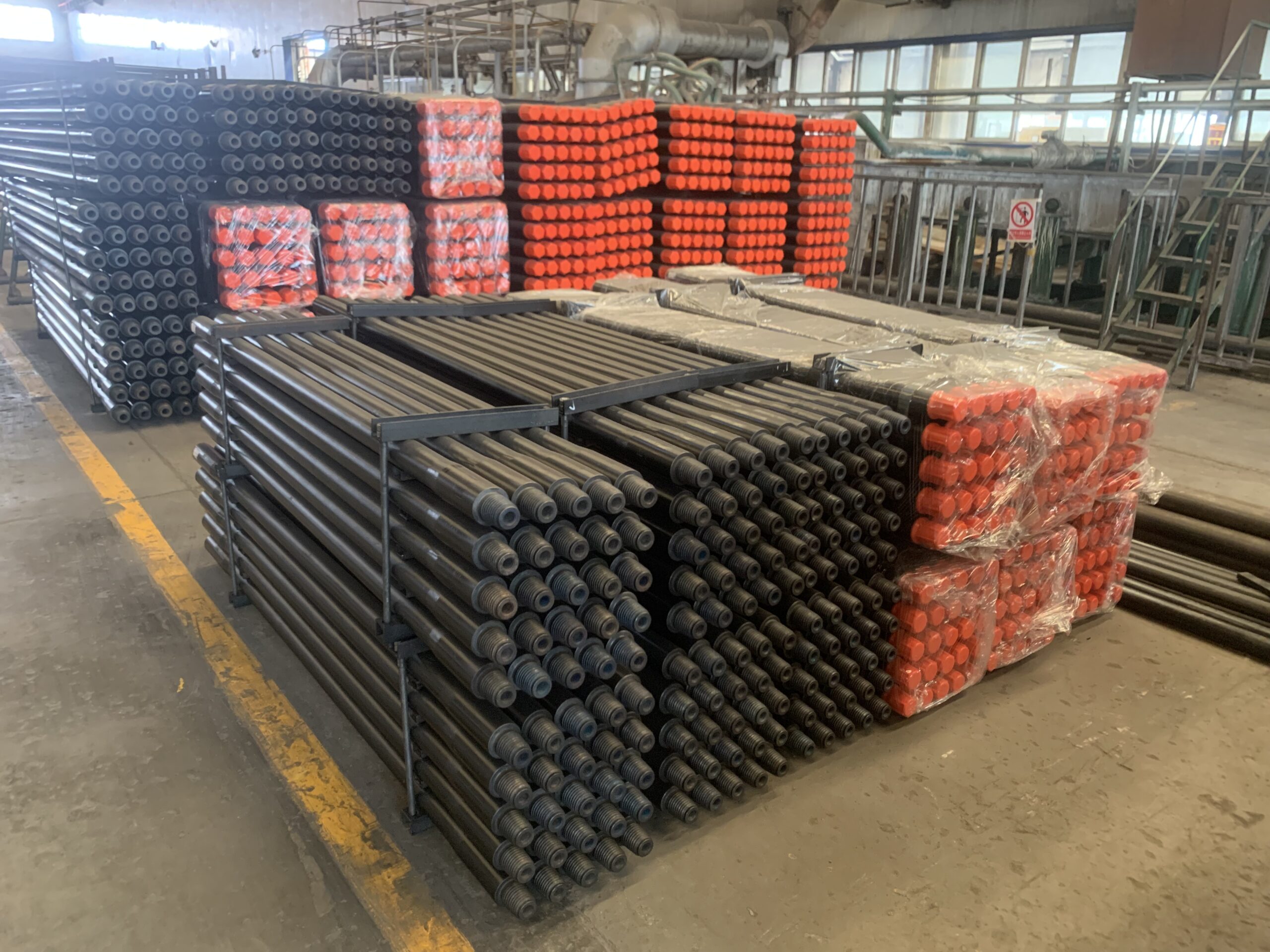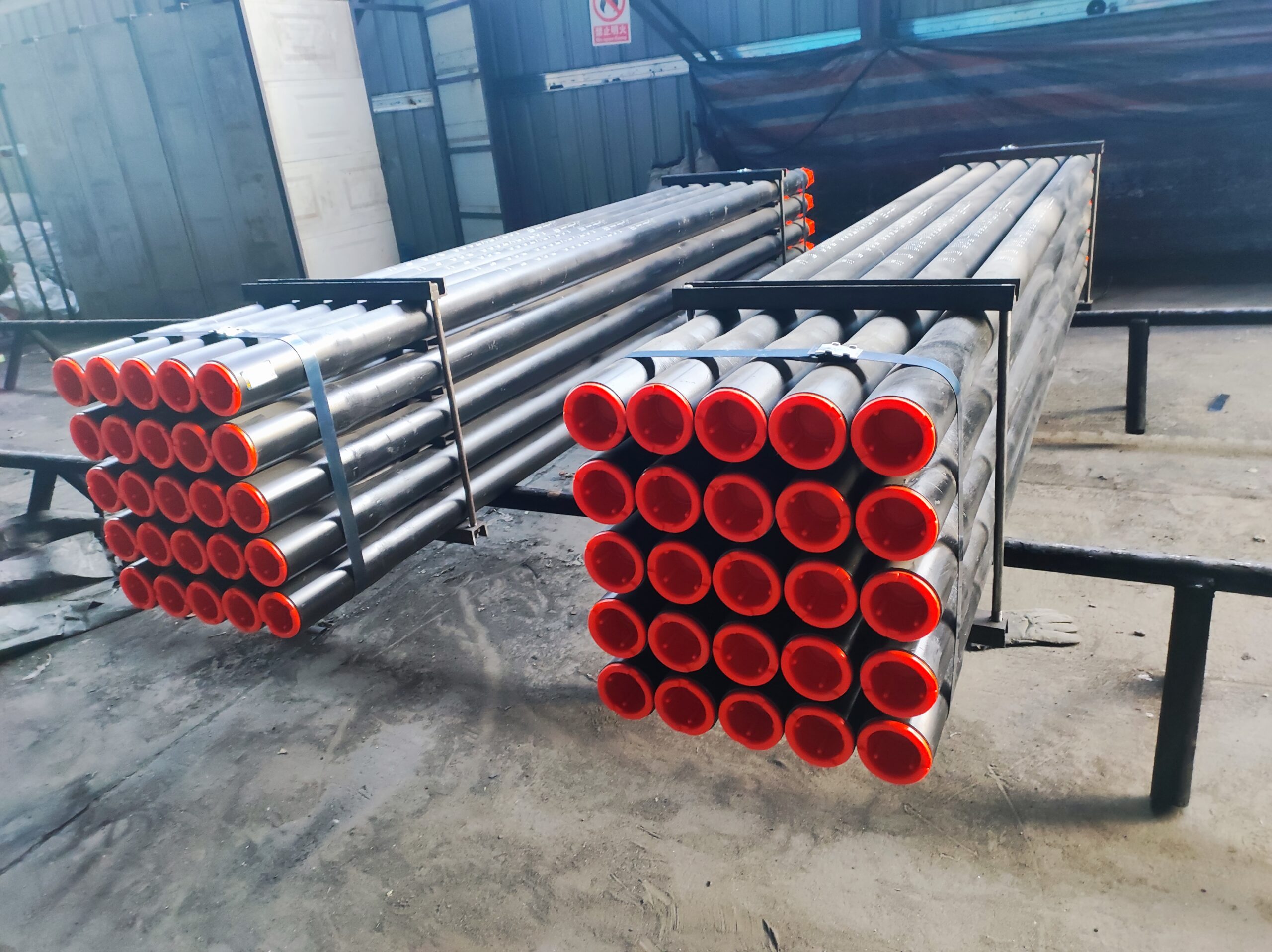
Drill pipe is one of the most heavily loaded components in a drilling system. During drilling, the pipe may simultaneously experience tensile load, compressive load, torsional load, bending stress, vibration, impact and repeated make-up and break-out cycles.
For horizontal directional drilling (HDD), these requirements become even more demanding because the drill string must transfer torque and thrust while following a curved bore path. A drill pipe with insufficient strength, poor dimensional accuracy or inconsistent thread quality can lead to premature wear, connection damage, reduced steering accuracy and even downhole failure.
The quality of drill pipe is therefore not determined by one factor alone. Three areas are particularly important:
- Material selection
- Manufacturing and heat-treatment processes
- Machining and inspection equipment
Understanding these three factors can help drilling contractors and distributors make better purchasing decisions.
1. Drill Pipe Material
The steel used for drill pipe provides the basic mechanical foundation of the product. Even excellent manufacturing equipment cannot compensate for unsuitable or inconsistent raw material.
1.1 Steel Grade and Mechanical Properties
Drill pipe is normally manufactured from high-strength alloy or low-alloy steels selected for a combination of tensile strength, toughness, fatigue resistance and controlled hardenability.
For HDD drill rods, high-strength materials such as S135-grade steel are widely used for demanding applications. Vermeer, for example, describes its Silver Series HDD drill rod as one-piece forged S135-grade steel.
The important material properties include:
- Yield strength
- Tensile strength
- Elongation
- Impact toughness
- Hardness
- Fatigue resistance
- Hardenability
- Microstructure stability
A higher nominal strength does not automatically mean a better drill pipe. The material must provide a balanced combination of strength and toughness.
A pipe that is extremely hard but lacks sufficient toughness may become more susceptible to cracking under repeated impact or bending. Conversely, material with insufficient strength may deform under high torque or pullback loads.
1.2 Chemical Composition
The chemical composition of steel directly influences its hardenability, strength, toughness and response to heat treatment.
Elements such as:
- Carbon
- Chromium
- Manganese
- Molybdenum
- Nickel
- Silicon
can affect the final mechanical properties.
For standardized oilfield drill pipe, chemical composition and microstructure are controlled requirements under API Spec 5DP. API’s current published updates include requirements related to chemical composition, microstructure and tool-joint hardness.
For buyers, this means that a reliable supplier should be able to provide material traceability and corresponding inspection documentation rather than simply stating a steel grade on a quotation.
1.3 Heat Treatment Capability of the Material
The same nominal steel grade can perform differently depending on how effectively it responds to the manufacturer’s heat-treatment process.
The material must be suitable for processes such as:
- Quenching
- Tempering
- Normalizing
- Stress relieving
The objective is not simply to increase hardness. The manufacturer needs to achieve a controlled microstructure and a suitable balance between strength and toughness.
This becomes especially important around the tool-joint area, where the connection experiences concentrated mechanical loads.
2. Manufacturing Process
Material quality establishes the potential performance of drill pipe, but the manufacturing process determines how consistently that potential is achieved.
2.1 Pipe Straightness
Straightness is critical for drilling performance.
An excessively bent drill pipe can:
- Increase friction
- Reduce steering accuracy
- Increase bending stress
- Accelerate thread and tool-joint wear
- Increase the possibility of fatigue failure
HDD drill pipes are intentionally designed to tolerate a controlled amount of bending because directional drilling requires steering. However, exceeding the manufacturer’s recommended bending limits can significantly shorten drill-pipe life.
For example, Ditch Witch documentation warns that excessive bending can cause damage that may not initially be visible but can accumulate and eventually result in drill pipe failure.
2.2 Forging and Tool-Joint Manufacturing
The tool joint is one of the most critical areas of an HDD drill rod.
A quality tool joint needs:
- Accurate geometry
- Adequate wall thickness
- Proper concentricity
- Controlled hardness
- Correct thread profile
- Proper shoulder contact
Poor tool-joint geometry can cause uneven load distribution during drilling.
This is particularly dangerous because repeated make-up and break-out cycles can amplify small dimensional errors.
2.3 Heat Treatment
Heat treatment is one of the most important stages in drill pipe manufacturing.
A typical process may include:
Heating → Austenitizing → Quenching → Tempering → Cooling → Hardness Inspection
The exact process depends on the steel grade, product design and manufacturer’s process specification.
Incorrect temperature control can result in:
- Excessive hardness
- Insufficient hardness
- Uneven hardness
- Distortion
- Residual stress
- Reduced fatigue resistance
API Spec 5DP also includes specific requirements concerning tool-joint hardness and hardness testing.
2.4 Thread Machining
Threads are among the most failure-sensitive features of a drill pipe.
A connection must transfer torque while maintaining proper shoulder contact and alignment.
Thread machining quality affects:
- Make-up torque
- Torque transmission
- Connection sealing
- Thread wear
- Galling resistance
- Fatigue life
Recent Vermeer guidance highlights that HDD rod connections depend on proper engagement between the pin nose, shoulder and thread flank. Incorrect thread geometry can create uneven loading and accelerate connection damage.
This is why two drill rods with identical pipe diameter can have very different service lives if their connection quality is different.
2.5 Inspection and Quality Control
A professional drill pipe manufacturing process should include multiple inspection stages.
Depending on product type and customer requirements, inspection can include:
- Dimensional inspection
- Straightness inspection
- Thread inspection
- Hardness testing
- Tensile testing
- Visual inspection
- Non-destructive testing
- Surface inspection
- Material traceability
The goal is to identify defects before the drill pipe enters the drilling site.
3. Machining Equipment
Even high-quality steel and a well-designed process cannot produce consistent drill pipe without suitable equipment.
3.1 CNC Threading Machines
Thread geometry must be controlled precisely.
Modern CNC equipment can provide better:
- Dimensional accuracy
- Thread repeatability
- Surface finish
- Concentricity
- Production consistency
For large-volume drill pipe manufacturing, automated CNC machining also reduces variation between individual pieces.
3.2 Heat-Treatment Equipment
A modern heat-treatment line should provide accurate control of:
- Heating temperature
- Heating time
- Cooling rate
- Quenching conditions
- Tempering temperature
- Process records
Temperature uniformity is particularly important because inconsistent heating can produce inconsistent mechanical properties.
3.3 Straightening Equipment
After heat treatment and machining, drill pipe may require controlled straightening.
Precision straightening equipment helps ensure that the finished pipe remains within the specified straightness tolerance.
3.4 Thread Gauging and Inspection Equipment
Thread inspection should not rely only on visual inspection.
Professional manufacturers can use:
- Thread gauges
- Coordinate measuring equipment
- Precision diameter gauges
- Surface inspection tools
- Torque testing equipment
For standardized products, the inspection system should correspond to the applicable specification and customer requirements.
4. How the Three Factors Work Together
The quality of drill pipe can be simplified as:
Material + Manufacturing Process + Equipment + Inspection = Final Product Quality
A high-quality steel grade cannot compensate for poor thread machining.
Advanced CNC equipment cannot compensate for unsuitable steel.
A good production process cannot compensate for inadequate quality control.
Therefore, buyers should evaluate the entire manufacturing system rather than focusing on only one specification such as steel grade or tensile strength.
5. What Should Buyers Check Before Purchasing Drill Pipe?
When purchasing drill pipe for HDD, oilfield drilling, water well drilling or other applications, buyers should ask suppliers for information about:
- Steel grade
- Chemical composition
- Heat-treatment process
- Mechanical properties
- Tool-joint material
- Thread type
- Pipe body diameter
- Tool-joint diameter
- Working length
- Straightness tolerance
- Hardness
- Inspection standard
- NDT requirements
- Material certificates
- Production traceability
For API oilfield drill pipe, buyers should also verify the applicable API specification and certification status rather than assuming that a product is API-compliant simply because “API” appears in a quotation.
Conclusion
High-quality drill pipe is the result of a controlled manufacturing system rather than a single material or production step.
Material determines the foundation. Manufacturing determines consistency. Machining equipment determines precision. Inspection determines whether the finished product meets the required specifications.
For drilling contractors, importers and distributors, understanding these three factors makes it much easier to compare suppliers and identify the difference between a low-cost drill pipe and a reliable long-service-life product.