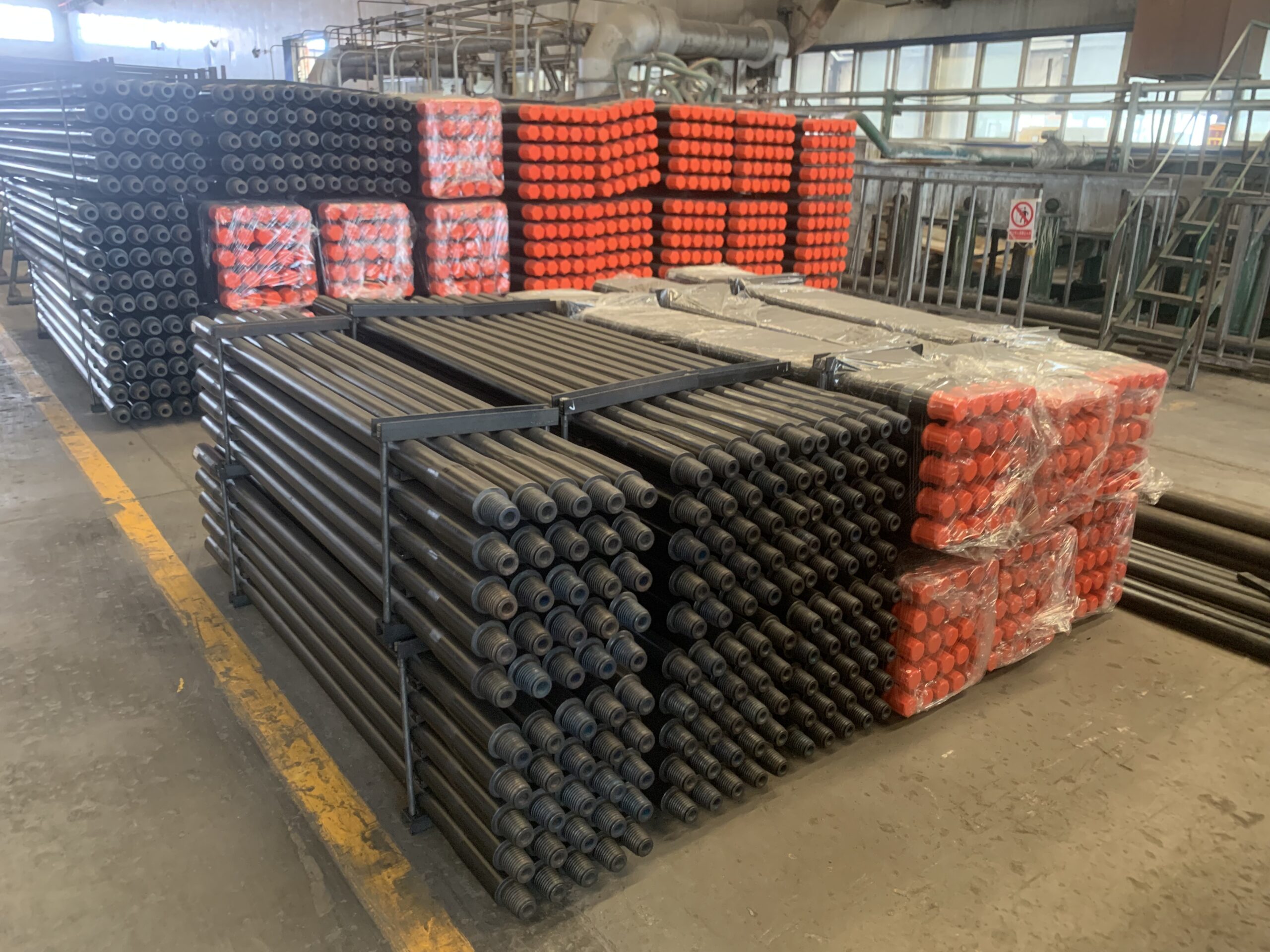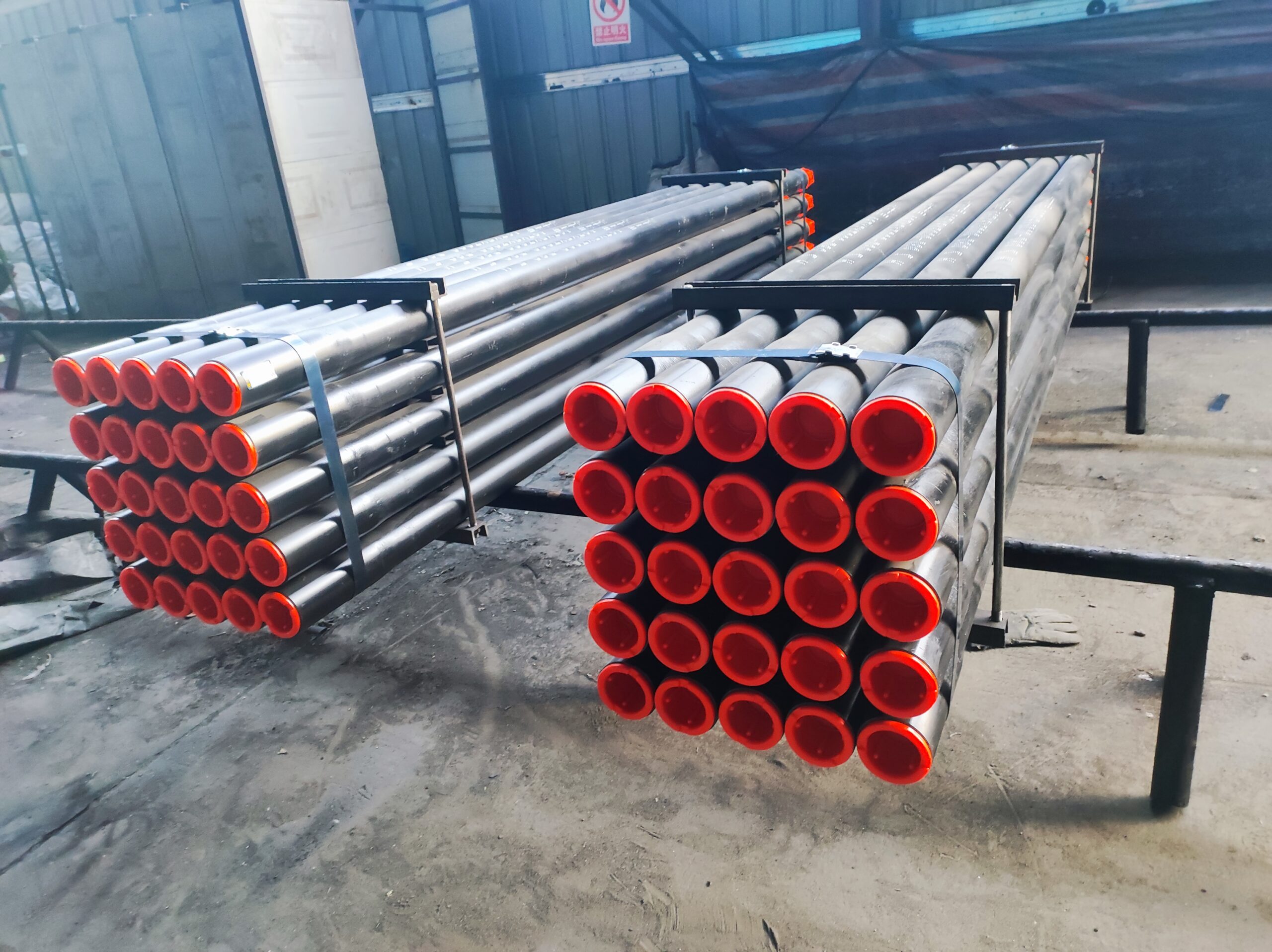
The production of drill pipes in China began in the 1990s. The production of drill pipes roughly consists of three parts: thickening of pipe ends, processing of tool joints, friction butt welding and subsequent treatment.
1.The pipe ends are thickened
The pipe body material of the oil drill pipe is low-carbon alloy steel. The round steel billets produced by continuous casting and continuous rolling are heated in a large rotary furnace and then enter the extension machine and the mandrel automatic drilling machine for forming. After being reheated, they undergo inner and outer diameter finishing and straightening before entering the heading forging process. As the weld seam of the oil drill pipe is the weakest link during use, the seamless pipe needs to be thickened at both ends of the pipe body before welding to increase the thickness and enhance the strength of the weak part, so that the overall strength of the weld seam is greater than that of the pipe body. According to the different pipe diameters, it is generally divided into three types: inner and outer thickened, inner thickened, and outer thickened, among which the inner and outer thickened type is the main one. The process of thickening the pipe end first involves heating and evenly heating the pipe end of the seamless pipe. Secondly, the pipe ends are hammered by hydraulic or pneumatic means. The outer surface is formed by a mold, while the inner surface is naturally formed by a temperature gradient. Finally, the entire pipe body undergoes heat treatment, straightening and non-destructive testing inspection. The key technology of thickened pipe at the pipe end lies in the forming of the transition zone on the inner surface. This part is the weakest and most complex in terms of force during use, with approximately 70% of accidents occurring here. Therefore, it is of vital importance to the quality of the drill pipe.
2.Tool joint processing
The material of tool joints is generally medium carbon alloy steel. The blank is formed by three stamping processes after heating, and then undergoes mechanical processing after normalizing. Firstly, the inner hole, outer circle and end face of the blank are turned. Secondly, the joint is subjected to quenching and tempering heat treatment to obtain comprehensive mechanical properties. Finally, the joint is threaded, and the threaded part needs to be copper-plated or phosphatized to prevent sticking during use.
The quality of the joint depends on two key processes: heat treatment and thread processing. The heat treatment structure directly affects the various mechanical properties of the joint. Therefore, advanced drill pipe factories adopt fully automatic continuous controllable atmosphere protection heating, quenching with oil or water-based quenching agents. During the heating process of the joint, reducing atmosphere protection is used to ensure that the workpiece does not oxidize, decarburize or carburize. After quenching and tempering of the joints, surface hardness testing and magnetic particle inspection are carried out one by one. After heat treatment, thread processing is carried out. The thread of the drill pipe is a coarse-threaded conical thread. During the connection process of the drill pipe, the thread plays a crucial role. Therefore, thread processing is mostly carried out by high-precision CNC machine tools. For each processed joint, parameters such as thread tightness, pitch, taper, and tooth height are measured one by one to ensure the thread shape and precision requirements, thereby effectively guaranteeing the connection performance of the drill pipe joint.
3.Friction butt welding and subsequent processing
Friction butt welding of drill pipes is an important part of the entire drill pipe production process. To ensure the welding quality, almost all drill pipe factories use fully automatic friction welding machines and are equipped with welding parameter monitoring devices to automatically monitor and record parameters such as friction time, friction pressure, top forging pressure, top forging time and shortening during the welding process, thereby ensuring the quality of the weld seam. After welding, the welding burrs need to be removed, the heat-affected zone of the welding should be quenched and tempered, and the weld seam should be inspected by non-destructive testing. Among them, the quenching and tempering heat treatment of the weld seam is of vital importance. Almost all manufacturers adopt medium-frequency heating methods and automatically record parameters such as heating temperature, heating time, holding time, and quenching time. The advantages of this weld heat treatment are: narrow heat-affected zone during heating and short heating time. The microstructure of the welding area is uniform and stable, and the performance is reliable. The residual stress on the surface of the welding area is small.